
By Steven Norris
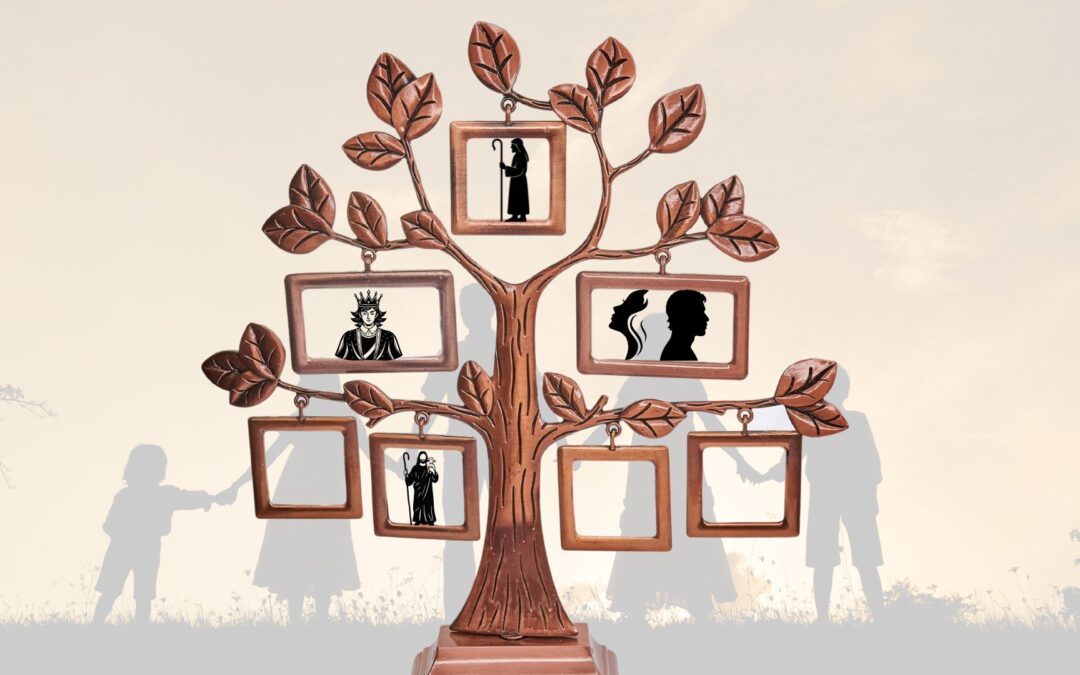
Where do you come from? Who are your people? The answers to such questions give context and location to a life. It is no surprise that the story of Jesus begins with a genealogy (Matthew 1:1-17) — tracing his lineage back to Israel’s origins and the authority of Israel’s monarchy. These connections would be expected for someone so significant to world history. Such roots, however, often go deep into potentially dark and hardened places that we might be tempted to hide from polite company.
For example, we find the name Tamar. After the death of her wicked husband, she finds herself childless and the kinsman redeemer unwilling to fulfill his duties, she takes matters into her own hands. When her father-in-law Judah passed by, he mistook her for a prostitute and gave her his staff and signet as an “I.O.U.” for her services, but she flees before he can return with payment. When her pregnancy was questioned, she produced the staff and signet as proof of paternity. Though scandalous to our modern ears, Judah testifies that she has been more faithful to the covenant than he (see Genesis 38).
Jesus’ genealogy includes Rahab, a prostitute from Jericho who assisted the Israelite spies sent to explore the Promised Land (Joshua 2).
It includes Ruth, whose Moabite ancestry can be traced to shockingly incestuous beginnings (Genesis 19:30-38). By any modern standard, she would be seen as an illegal immigrant (her mother-in-law instructed her to return to her own people), a strain on the welfare system (the practice of gleaning was meant to take care of the most vulnerable Israelites), and as one who seduced Boaz (to “uncover his feet” was a euphemism for sexual advances).
The family tree includes Bathsheba (though her name is excluded). Her relationship with David was not a passionate love affair. Given King David’s position, it is unlikely that she had any agency in the relationship. Not only was she a victim of sexual assault, but David went so far as to have her husband killed to cover for his sin.
Finally, I can only imagine the ridicule Mary must have experienced after her pregnancy was discovered. Her fiancée, Joseph chose to protect her rather than subject her to punishment. I wonder if those questions followed Jesus throughout his childhood.
In such a highly patriarchal culture, Matthew could have told this story without including these women, but he did not. He does so, not to excuse or overlook sin, but to remind us that Jesus shows up in the depths of our pain. He shows up in the midst of hurtful words, unwed pregnancies, addictive behaviors, wayward children, failed marriages, physical and mental illness, lost jobs, compromised business decisions, and seasons of doubt and uncertainty. Matthew includes these stories to remind us that Jesus shows up in the chaos of real life.
As we walk the road of Advent, do not let the serene perfection of Christmas cards and familiar carols dull the shock of Emmanuel — God with us — in all our mess and chaos. In God’s plan, we will not find perfect families or perfect circumstances, only perfect love that makes room for us all in God’s story of redemption.