By Steven Norris
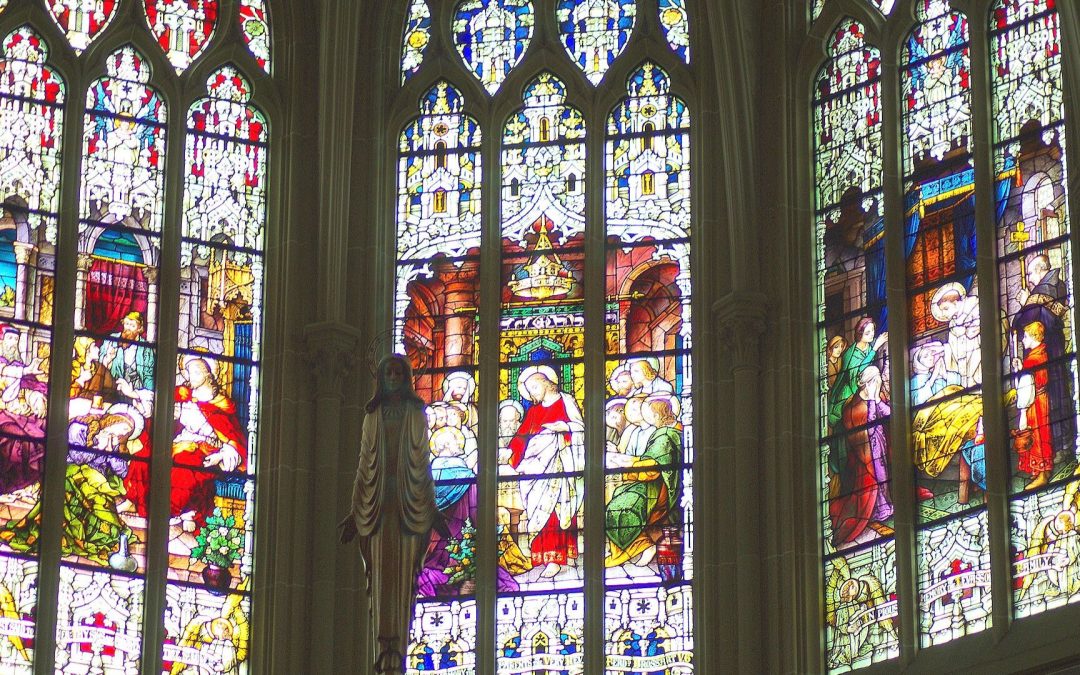
Some places in this world are indescribably different. Set apart. Sacred. Transcendent. While traveling last spring, my wife and I visited just such a place in Covington, KY. The first time I entered the Cathedral Basilica of the Assumption, I knew something was unique. Maybe it was the gothic architecture, the stained glass, the mosaics on the wall, the sounds of prayers offered, or the smell of incense, but I knew that this place was special.
Truthfully, the component parts were familiar — brick, stone, tile, wood, glass, and fabric — but the assembly of those parts drew the eye and the heart in a way that was emotionally and spiritually moving. I returned to the cathedral at least once a day for the remainder of our trip. I noted that visitors spoke in hushed tones, as though entry had invited them into reverence and awe. Though I did not personally witness it, I would not have been surprised me to see worshippers removing their shoes upon entering.
For centuries, church architecture was used to help “preach the gospel.” The symbols and structure invite guests into a divine encounter where the divisions between the finite and the infinite blur. For this reason, special language is often used to describe church architecture. The place where worshippers gather is referred to as the “nave.” It comes from the Latin word navis, meaning “boat” or “ship” and is intended to bring to mind the familiar story of Noah’s Ark. The ark (navis) was a place of refuge and safety from the storms raging just outside its hull. Similarly, the church is intended to be a “sanctuary,” a place of refuge from the storms of life.
Such holy sanctuaries need not be confined to physical spaces, however. Rabbi Abraham Joshua Heschel famously referred to the Sabbath as “a sanctuary in time.” I cannot help but think that we stand at the cusp of a similar “sanctuary in time.”
For Christians, next week is referred to as “Holy Week.” The faithful will follow the story of Jesus as he rides into Jerusalem on Palm Sunday; flips the tables of the moneychangers; criticizes religious hypocrisy; washes the disciples’ feet; breaks bread at the Last Supper; faces a trial before Pilate; receives a brutal beating at the hands of the Romans; is crucified next to two thieves; is buried in a borrowed tomb; and rises on the third day.
The events remembered this week have the power to revolutionize the world, transforming individuals who allow its message to take root in our hearts. Therefore, I urge you: this is not a week for business-as-usual. This is the kind of week we enter intoreverently. This is the kind of week before which we remove our shoes. This is the kind of week that we walk through slowly, reflectively, somberly, and gratefully.
Don’t rush ahead to Easter Sunday because you are hungry for the pomp and celebration. Enter the sanctuary of Holy Week and dare to be transformed.