
I pray that. . . Christ may dwell in your hearts through faith, as you are being rooted and grounded in love. (Ephesians 3:16)
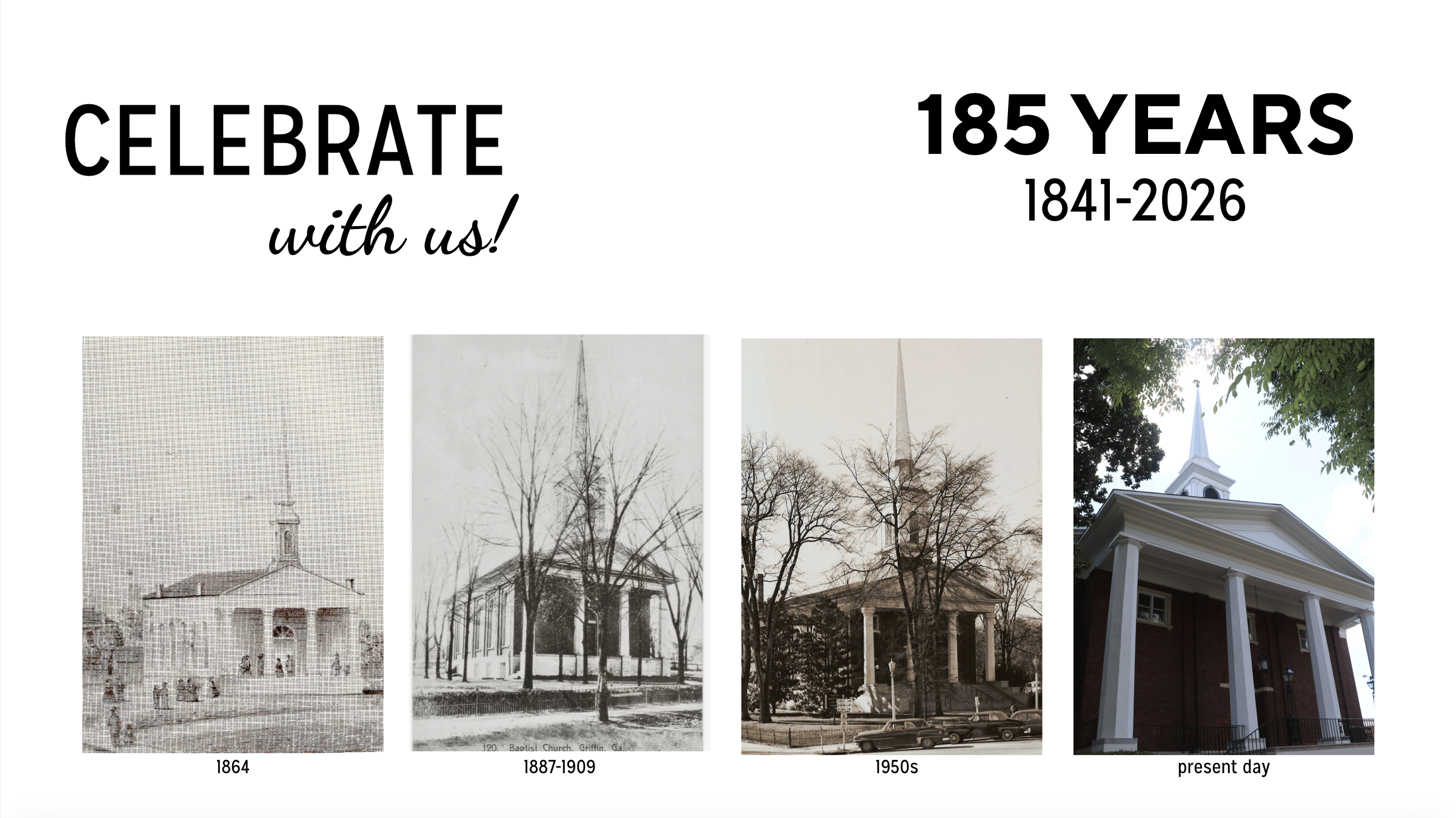
We are all looking for roots to hold us steady and for solid ground upon which we can stand secure in the midst of uncertainty. First Baptist Griffin extends an invitation to you — come and experience for yourself the longstanding commitment to walking in the way of Jesus found here. Give us an opportunity to welcome you into this community of grace. This year, we celebrate 185 years of ministry, and on this page we would like to share a bit of that history with you. You will also find information about our anniversary celebration here. As you explore our history on this page, we hope you will be inspired to drop in and get to know us better in person.
Relive the Worship
Our One Church worship service in the Sanctuary gave us the opportunity to visit with old friends — FBC family — who joined us in song, study, and reflection on our long history and our spiritual walk together. Watch the service again here.
Experience the Reflections on a lifetime at FBC
If you missed our 185th Anniversary Celebration luncheon, we invite you to watch this video where members reflect on their experiences at FBC over the years. Many thanks go out to Alice Blake, Marian Sorenson, Steven Norris, our speakers — Valerie Rogers, Gail Hammock, Betsy Jones, Bonnie Brown, Juli & Kenneth Moore, Sallianne Haredwick (and Rawls), Brad Glass, and Adam Pugh — Leila Wells Rogers, and the Church Library team for their help in curating photos.
How did we get our start?
The following history has been curated by Alice Blake.
On January 30, 1841, fourteen Baptists (8 women and six men) met to organize a church and adopted a resolution to form a Presbytery to constitute a church on the first Saturday of March. Due to bad weather, that meeting took place on Sunday, March 7, 1841, and the Baptist Church of Griffin was founded with these members: Albert G. Colbert, Catharine Colbert, A.B. Reid, James Butler, Aley Butler, Eleanor But, Pitt S. Milner, Pamelia N. Milner, Margaret Smith, Latitia Falkner, Francis Tornell, Mary Tornell, Eleanor Tornell, and Samuel Tornell.
During the meeting of the Presbytery in 1841, Reverend Spencer Stamper preached from John 3:3 [“Jesus answered and said unto him, ‘Verily, verily, I say unto thee, Except a man be born again, he cannot see the kingdom of God.'”] and Reverend Joshua S. Callaway preached from Song of Solomon 1:10 [“Thy cheeks are comely with rows of jewels, thy neck with chains of gold.”] At a meeting the next week, the church called Brother Callaway to be their pastor. Recent research revealed that founding member Pitt Saunders Milner was a nephew of Joshua Sandford Callaway, the first pastor of this church, whose sister was Pitt’s mother. Pitt’s brother Benjamin Mosely Milner built two houses that still stand on South Hill Street (570 and 708).
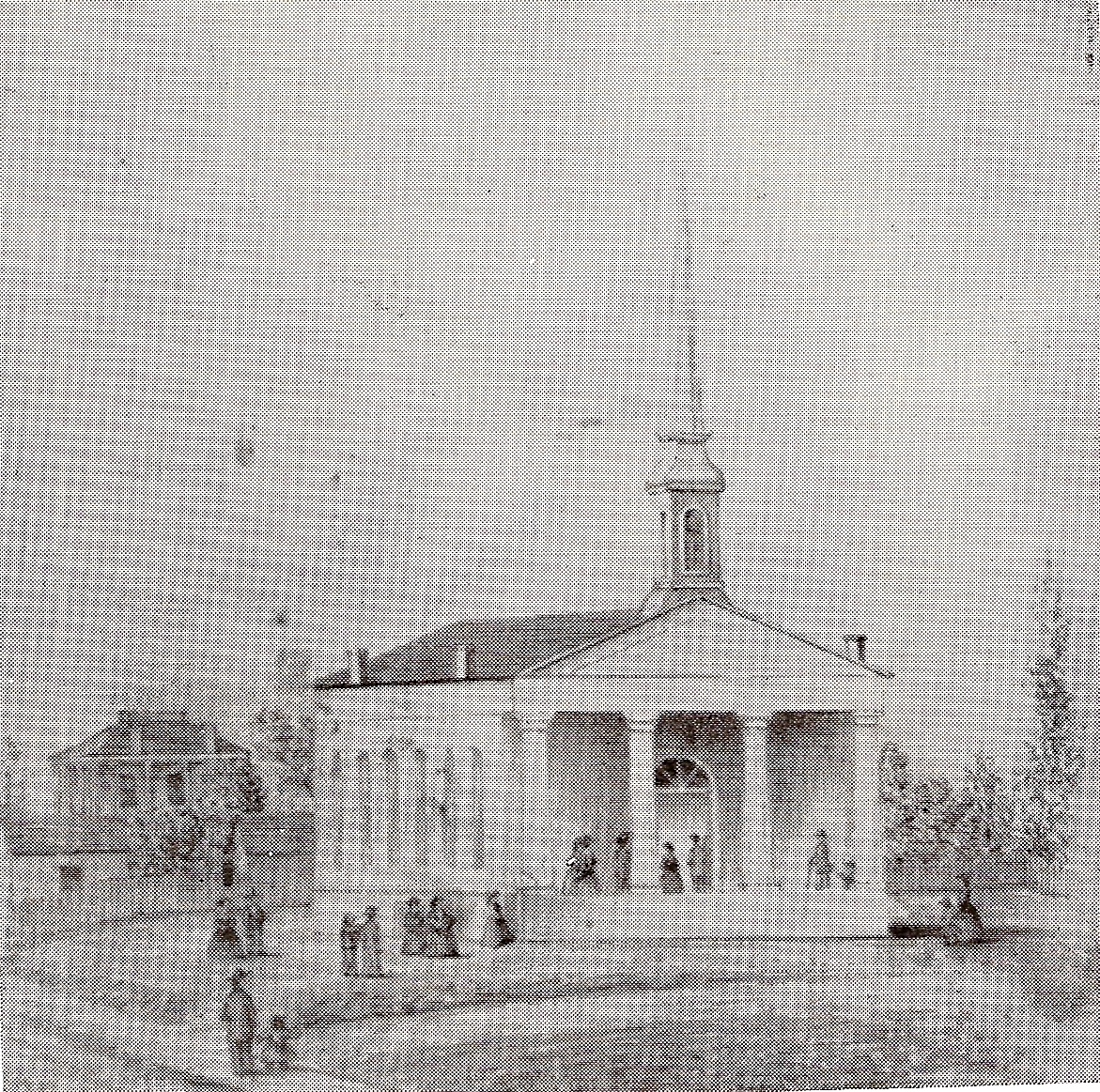
First Baptist Church, 1864
In 1845, the church took possession of the lot on Solomon Street that Gen. Griffin had designated for a Baptist church and erected “a suitable House for the Worship of God” in 1846. This small wooden building cost about $1,500.00.The church minutes state that Reverend Campbell, who was called to the church in 1853, “served the church two Sabbaths in each month.” It is likely that other early pastors served more than one church at a time. Most pastorates were short-lived, lasting from one to a few years.
In 1859 the church lot was divided into smaller lots to be offered for sale. One purchaser was Henry B. Holliday, father of the infamous “Doc” Holliday, John Henry Holliday. Proceeds from the sale totaled “near Fifteen thousand Dollars.” Thereafter, “a suitable lot was purchased and a building Committee appointed.” Mr. Rabbitt, an Atlanta architect, drew plans and Mr. McElfresh, a Marietta building contractor, were hired. The property purchased was located on the south side of Taylor Street between Hill and Eighth Streets, but the church soon sold the western part of the property and began construction at the corner where the church building is located today.
What do we know about our role during the Civil War?
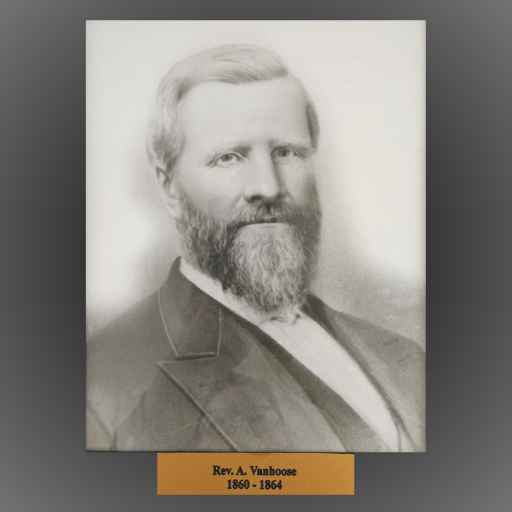
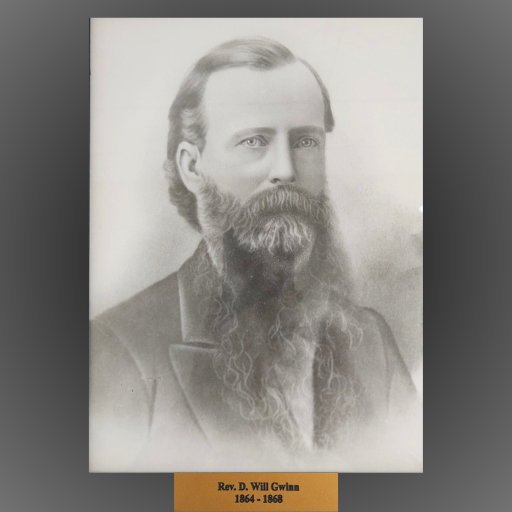
The Rev. A. Vanhoose served First Baptist Church from 1860 until 1864. From 1864 until 1868, Rev. D. Will Gwinn led the church. We have not been able to find proof that the church served as a hospital during the war, but a letter dated October 7, 1864, from the pastor, Reverend David William Gwin, to The Christian Index, describes the local situation.
“I have been engaged for several months almost continuously with the Griffin Relief Committee. We have lifted, nursed, furnished bandages and medicines, fed, comforted and otherwise relieved, thousands of our noble soldiers…My pastoral work has been neglected on this account. True, I have been at home a portion of my time, but was unfitted for pastoral visiting. But what Church ought to forbid its minister from laboring in such a field?”
Susan G. Martin (later Mrs. Pope) was a student at the Synodical Female College on South Sixth Street in Griffin during the Civil War. This passage from her Reminiscences is quoted from History of Griffin, Ga. 1840-1940 by Quimby Melton, Jr., page 74:
After the long years of anxiety, it was terrible to see each train that came into Griffin bring dozens of wounded and sick soldiers. Soon the hospitals overflowed, and the Courthouse, public buildings, stores, colleges and even private homes, were filled with cots and the patients made as comfortable as possible with the limited means we possessed. Already, we had used our linen underwear, sheets and table linen for bandages, and raveled them into lint for wound dressings.”
“During the calamities incident to the War the church Minutes from the year 1847 up to the December conference in the year 1864 were lost or destroyed”; therefore, a committee was appointed to “revise” or reconstruct them. The committee’s report is the only record we have of these early years of church history, and for a hundred and fifty years that is all we knew about what happened to the minutes, until we found this item in The Christian Index, March 30, 1865:
“Bro. Gwin informs us that Wheeler’s men broke into the store of a deacon and took away, among other things, the church minute-book.”
To add further intrigue to the saga of the minutes, Kate Cummings, who worked for the hospitals of the Army of Tennessee and was in Griffin from March 9 to May 1865, wrote in her journal published in 1866:
[April 20] “One of the stories afloat is, that they [Federal troops] had no idea of coming here; but the mayor and some of the citizens met them some miles from town, and offered to surrender the city if they would spare private property. There were not more than one hundred. They were a detachment from the main body, who have gone on to capture Macon. I am told that the captain boasted that, last year, when Sherman went through the eastern portion of this state, he, along with many others, had come to Griffin, dressed in Confederate uniform, calling themselves Wheeler’s men. They then broke open stores and took out what they pleased. They said they had often done so. This will, likely, account for the bad repute of Wheeler’s men.”
[General Wheeler made his headquarters in a house that is still standing at the corner of South Hill Street and Tilney Avenue. Until several years ago, the street between Hill and Sixth Streets was named Wheeler Place.]
In 1866 the church name changed to First Baptist Church of Griffin because another Baptist church had been organized in the city. Some members left our church in a dispute about the use of an organ during worship services. We don’t know which faction organized a separate church. First Baptist called the Reverend J. H. DeVotie to be pastor in 1870 and he managed to reunite the two factions.
Blanche Drewry Westbrook came to this church in 1866 when she was seven years old. She recounted interesting details about the church in the 1870s in a memoir that we have made available in our Welcome Center. Sunday School in those days was for the children and met on Sunday afternoons. Young children were given Bible verses to memorize. Those twelve and thirteen years old memorized Romans 12, 1 Corinthians 13, or Matthew 5, 6, or 7 and recited them to the pastor. Ms. Westbrook classified recitations as “Scary times.” The choir director, Joe Lowenstein, “was a Hebrew, a fine violinist & knew music. ‘He called himself Brother-in-law to the Baptist church which was next thing to a Jewish Synagogue.’”
For decades members were required to attend church services and monthly church conferences. If they missed a meeting, they had to ask to be excused. March 1866 conference minutes state: “Acknowledgments from offenders having been called for Sisters Ellen George & Laura Thomas both apologized to the Church for having been guilty of the offense of dancing & were on motion forgiven by the Conference…James M. Bloodworth charged with absence from Conference & unchristian conduct. Ed Brown charged with neglect of Christian duties & absence from Conference. George Jones charged with neglect of Christian duties & absence from conference. Robert White charged with Drunkenness. S. Burnett charged with absence from Conference. Mrs. Stark charged with permitting dancing at her house.” Similar situations were addressed years later, for example this entry in the May 9, 1888 conference minutes: “The following report of Diciplinary [sic] committee read and adopted…In our effort since last conference to induce those of our members who have been dancing to refrain from said practice. Report as follows. We have found one—Bro. Will Flemister who claims the right to dance whenever he may see proper and also declines making any promise whatever to conform to the rule of the church upon dancing. Your committee have visited and labored with him repitedly [sic] and are of the opinion we cannot effect any good by further effort…On motion T.J. Collier the church withdrew fellowship from Said Brother.” Will Flemister was a young man in his early twenties. He married a few years later, fathered Lucille Flemister (the artist who drew a familiar sketch of the church) and was for a long time a member in good standing of First Baptist.
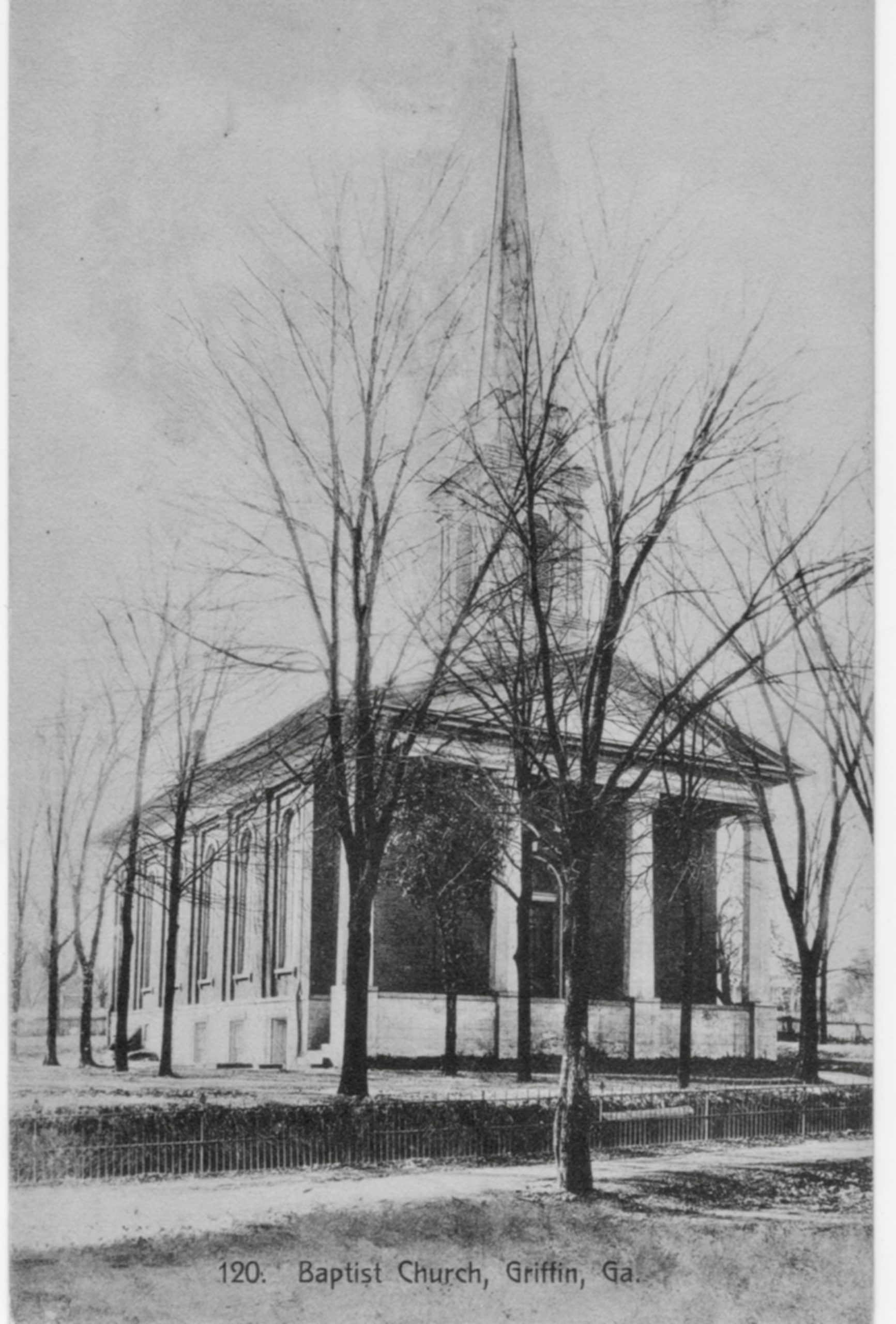
First Baptist Church, 1909
FBC helped organize these churches, most of which began as missions:
1867 Mt. Zion Baptist Church (organized by the black members of First Baptist)
1888 DeVotie Baptist Church
1894 McIntosh Baptist Church
1901 East Griffin Baptist Church
1902 Oak Hill Baptist Church
1905 Second Baptist Church
1944 Calvary Baptist Church (now Lifesong Church)
1949 Edward Street Baptist Church
1953 Vineyard Baptist Church
1955 Southside Baptist Church
1957 West College Street Baptist Church (now Sharon Baptist Church)
Watch this page for more FBC history as we celebrate 185 years of ministry!