
By Steven Norris
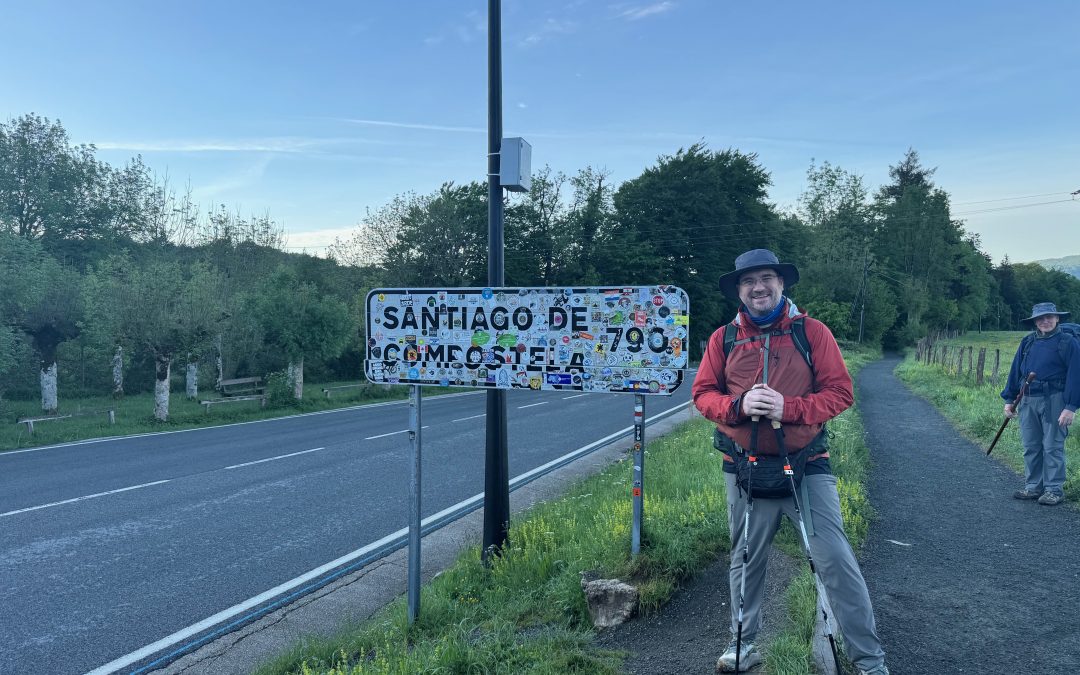
I’ve never really thought of myself as a pilgrim until recently. Well, there was that time in elementary school when I dressed up in black and white for the annual Thanksgiving program. In high school, I visited the Vatican, but it was as a musician, not as a spiritual seeker. Therefore, when my plane left the familiar Georgia clay this past May, I knew I was about to experience something altogether new.
Pilgrims are those who journey to some sacred place. It may be a monastery atop a remote mountain or a shrine where the bones of some long-dead saint are kept. They go with the conviction that there are some places where the separation between this world and the next seems less pronounced. The ancient Celts called these “thin places.”
The Camino de Santiago (The Way of St. James) is an ancient pilgrim’s path across northern Spain. According to tradition, James, the apostle of Jesus, took the message of Christ to the Iberian Peninsula following the events of Pentecost. After his death in Jerusalem, followers transported his remains to northwest Spain so that he could rest among those to whom he had ministered in life.
Since medieval times, the road to Santiago de Compostela has been a popular pilgrim route for those seeking an encounter with the Divine. Christians (Catholic and Protestant), spiritual seekers, and those of no faith have set out to walk the 500+ miles from southwest France to the city of Compostela. They do so with the conviction that the journey is more important than arriving at a specific destination, for it is the quest that forces pilgrims to confront themselves — their fears, regrets, victories, defeats, convictions, and doubts.
Over the next few weeks, I’d like to share with the readers of this column a few stories that I’ve brought back from the pilgrim’s trail. I do this because I believe that we are all called to be pilgrims in life. We are created for communion with God and are, therefore, in search of places and circumstances that help foster that deep connection. The Bible declares, “Blessed are those whose strength is in [God], whose hearts are set on pilgrimage” (Psalm 84:5).
Likewise, Judeo-Christian history is one of pilgrimage. The people of God know what it is like to be in exile in a foreign land — whether that is Egypt, Babylon, or any other foreign land. Believers today often sense that their true home is found as a citizen of God’s heavenly kingdom. Therefore, we set out in search of “thin places” where God’s presence can be more tangibly felt.
What places give you a sense of being in the presence of something truly holy and transcendent? The mountains? The beach? A cathedral with radiant light filtering through stained glass? The full spectrum splendor of a sunset? Standing before an artistic masterpiece or listening to the soaring strains of a symphony?
Christine Valters reminds us, “God is never a set of concepts to be understood, but a relationship to encounter. In this way, the spiritual life is always a journey.” In what ways is the Spirit inviting you to pilgrimage today?